3D Dynamic Laser Marking for Automotive Parts: Applications, Benefits & Traceability
Automotive parts are becoming more complex.
From engine and transmission components to EV motor housings, battery-related components, brake systems, and aluminum housings, many automotive parts are no longer simple flat surfaces. They may contain curved surfaces, different working heights, recessed areas, inclined sections, or large marking zones.
At the same time, automotive manufacturers and suppliers need reliable part identification and traceability throughout production and the supply chain.
This creates a practical challenge:
How can manufacturers place permanent, readable identification marks on complex automotive components without compromising marking quality or production efficiency?
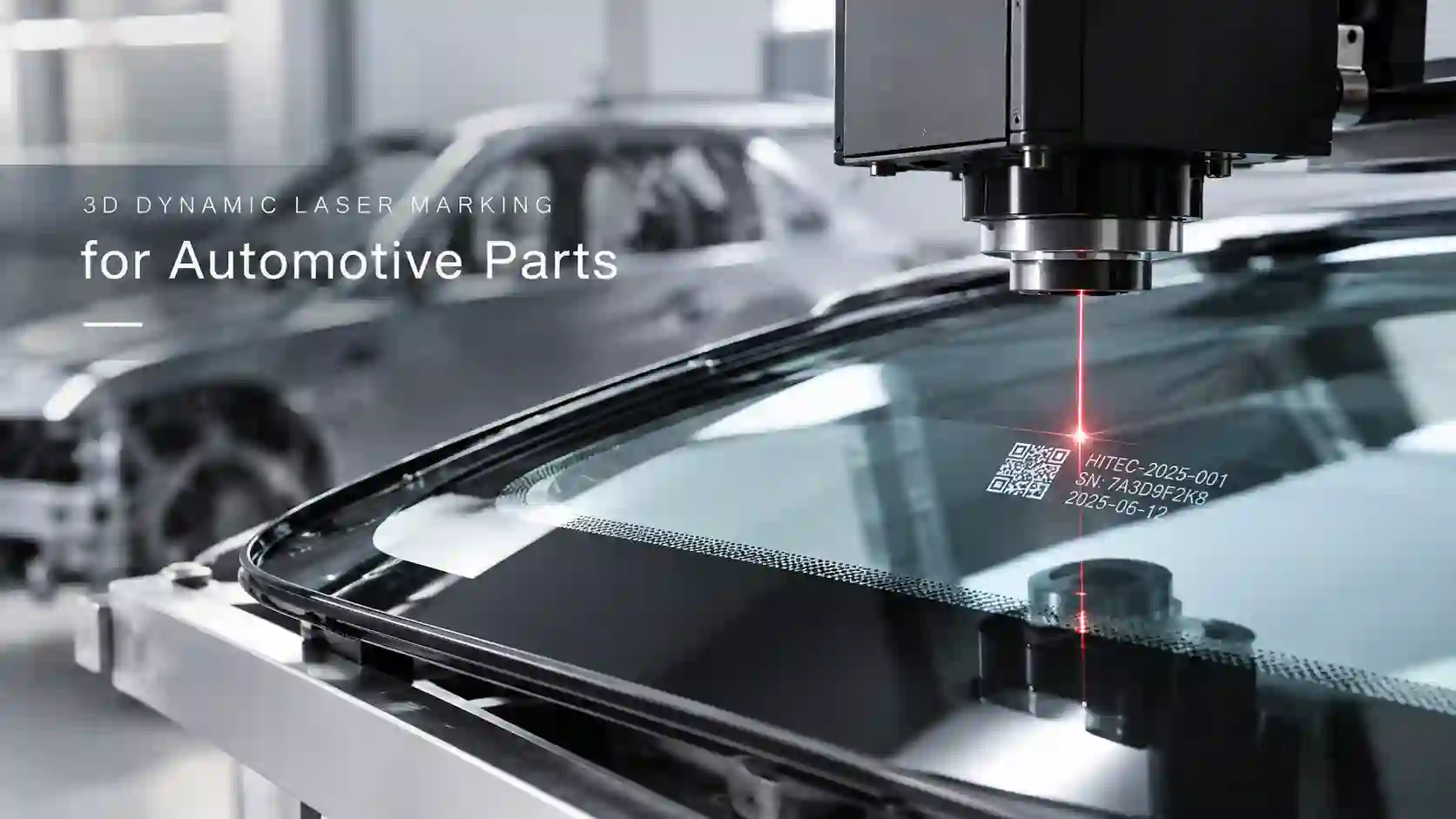
3D dynamic laser marking provides one solution by dynamically controlling the laser focus across changes in surface height within the system’s specified working range.
Unlike conventional 2D laser marking, which is optimized around a fixed focal plane, a 3D dynamic system can compensate for certain Z-axis changes during marking. This makes it particularly useful for automotive components with curved, inclined, stepped, or otherwise non-flat marking surfaces.
Why Is Laser Marking Important in Automotive Manufacturing?
Automotive manufacturers produce millions of individual components, often through multi-stage supply chains involving OEMs, Tier 1 suppliers, Tier 2 suppliers, and specialized component manufacturers.
A part may need to be identified by:
• Part number
• Serial number
• Data Matrix code
• QR code
• Production code
• Batch number
• Manufacturing date
• Brand or supplier identification
Technical information
AIAG’s automotive parts identification and tracking guidance specifically recognizes Data Matrix and QR Code among the 2D symbologies used for automotive part identification and tracking. AIAG also maintains a dedicated traceability guideline focused on improving product visibility throughout the automotive supply chain.
What Is 3D Dynamic Laser Marking?
3D dynamic laser marking uses a dynamic focusing system to adjust the laser’s focal position while the beam moves across the marking area.
A conventional 2D galvo system generally works around a defined focal plane:
Flat surface → consistent focus → marking
When the surface height changes significantly, the laser’s relationship with the workpiece also changes.
A 3D dynamic system introduces another dimension:
X + Y scanning + dynamic Z focus compensation
This allows the laser to maintain a more suitable focus position across qualified changes in surface height.
Research into 3D laser marking has demonstrated the use of dynamic focusing for marking and engraving tilted, curved, and freeform surfaces, while modern industrial systems use dynamic-focus optics to extend marking capability beyond a single flat focal plane.
However, 3D dynamic marking does not mean that every three-dimensional component can automatically be marked perfectly.
The actual result depends on:
• Surface geometry
• Height variation
• Marking area
• Optical configuration
• Laser source
• Material
• Marking depth
• Required code quality
• Part positioning
• Software and process parameters
For this reason, application testing on the actual automotive component remains important.
Where Is 3D Dynamic Laser Marking Used in Automotive Parts?
- Engine Components
Engine components can contain complex geometries, recessed areas, curved surfaces, and different material finishes.
Potential applications include:
• Engine housings
• Cylinder-related components
• Pistons
• Camshaft components
• Bearings
• Brackets
• Valves
• Aluminum engine components
Laser marking can be used for:
Part numbers · Serial numbers · Production codes · Data Matrix · Logos · Identification marks
The objective is usually not simply to create a visible mark, but to create a permanent and machine-readable identification point.
- Transmission & Drivetrain Components
Transmission and drivetrain components often require durable identification throughout manufacturing and service life.
Examples include:
• Transmission housings
• Gears
• Shafts
• Clutch components
• Aluminum housings
• Mechanical brackets
• Drivetrain components
For these applications, a marking system may need to work around curved or uneven surfaces rather than a perfectly flat plate.
This is one area where the ability to dynamically compensate for surface height can become useful.
- Brake and Suspension Components
Automotive braking and suspension systems contain many components where identification and production tracking can be important.
Applications can include:
- Brake components
- Calipers
- Suspension parts
- Steering components
- Mounting brackets
- Structural metal components
Depending on the component and marking specification, manufacturers may require:
- Data Matrix codes
- Serial numbers
- Part numbers
- Batch identification
- Supplier codes
- Permanent text or symbols
Automotive laser-marking applications already include brake systems, bearings, gears, engine components, and other parts where permanent identification supports manufacturing and traceability.
- EV Motor Housings and Aluminum Components
The growth of electric vehicles creates another important application area.
Global electric-car production reached nearly 22 million vehicles in 2025, according to the IEA, representing more than 25% growth compared with 2024.
EV manufacturing introduces large numbers of electrical, thermal-management, motor, housing, and battery-related components into automotive production.
Many of these components are made from aluminum or other metals and can have:
- Large surface areas
- Curved housings
- Recessed sections
- Different surface heights
- Machined surfaces
- Coated surfaces
This creates opportunities for flexible laser marking solutions capable of handling more than a simple flat marking plane.
Typical applications may include:
Motor housings · Inverter housings · Aluminum components · Cooling components · Electrical housings · EV structural components
The exact laser source and power should always be selected according to the material, surface treatment, required contrast, marking depth, and production requirements.
- Automotive Electronics
Modern vehicles contain a growing number of electronic and electrical components.
Examples include:
- Electronic modules
- Sensors
- Connectors
- Controllers
- Inverter components
- Electrical housings
Identification may include:
- Serial numbers
- Data Matrix codes
- QR codes
- Component IDs
- Manufacturing codes
For electronic components, the challenge is often not simply making a mark visible.
The mark may need to be:
Small + consistent + readable + permanent + compatible with automated scanning.
This makes process control and code verification just as important as laser power.
- Automotive Interior and Exterior Components
Laser marking is also used beyond mechanical components.
Depending on material and surface treatment, applications can include:
- Interior trim
- Metal decorative components
- Switch components
- Control panels
- Exterior identification
- Aluminum nameplates
- Functional markings
For these applications, appearance can become more important.
The manufacturer may require a combination of:
Visual quality + contrast + consistency + durability.
3D Dynamic Laser Marking vs. Conventional 2D Laser Marking
A common misunderstanding is that a 3D dynamic laser marking machine should replace every conventional 2D laser marker.
That is not the right way to evaluate the technology.
For a flat automotive component with a consistent working height, a conventional 2D galvo system can be entirely suitable.
3D dynamic marking becomes more interesting when surface geometry itself becomes part of the marking challenge.
Application Requirement | Conventional 2D Galvo | 3D Dynamic Galvo |
Flat metal surface | ✓ | ✓ |
Fixed focal plane | ✓ | ✓ |
Moderate surface variation | Limited | ✓ |
Curved / inclined surface | Application dependent | Better suited |
Different Z heights within qualified range | Limited | ✓ |
Large 3D marking area | Application dependent | ✓ |
Dynamic focal compensation | — | ✓ |
Complex freeform surface | Requires evaluation | Requires evaluation |
The important point is:
3D dynamic focusing expands the usable process window; it does not eliminate the need for application engineering.
What Are the Main Benefits for Automotive Manufacturers?
- Better Adaptation to Complex Surfaces
The biggest technical advantage is the ability to compensate for changes in surface height within the qualified 3D range.
This can be valuable when a part cannot be easily reduced to a single flat marking plane.
- Permanent Identification
Laser marking is a non-contact process and can produce permanent marks without using labels or consumable inks.
For automotive components exposed to vibration, temperature changes, handling, or chemical environments, the marking process must be selected according to the required durability and material.
The objective is to create identification that remains readable throughout the required manufacturing or service lifecycle.
- Support for Traceability
This is arguably one of the most important benefits.
A laser-marked Data Matrix or serial number can provide the physical identification needed to connect a component to manufacturing records.
AIAG describes traceability as a way to provide product visibility through the supply chain and help reduce the scope of recalls caused by non-conforming products.
In practice, the laser itself does not create traceability.
The laser creates the physical identifier.
The complete traceability system may also include:
- Code generation
- Database management
- Barcode/Data Matrix readers
- MES integration
- Production records
- Quality inspection
- Serialization
- Verification systems
This distinction is important when designing an industrial marking solution.
- Reduced Dependence on Mechanical Contact
Because laser marking is non-contact, there is no engraving tool physically pressing against the component.
This can be useful for precision-machined parts or components where mechanical tooling could introduce additional contact, wear, or setup requirements.
- Flexible Product Identification
Automotive suppliers frequently manufacture multiple variants of components.
A software-controlled laser marking system can change:
- Text
- Serial numbers
- Codes
- Graphics
- Part numbers
Production information
without requiring a new physical engraving tool for every marking variation.
This flexibility can be particularly useful in high-mix manufacturing environments.
- Potential for Automation
3D dynamic laser marking can also be integrated into automated production lines.
Depending on the application, a system may be combined with:
- Automatic loading
- Part positioning
- Barcode scanning
- Vision inspection
- Code verification
- MES communication
- Robotic handling
Conveyor systems
The laser marking machine therefore does not have to operate as an isolated workstation.
It can become one process inside a larger manufacturing and traceability workflow.
What Should Automotive Manufacturers Consider Before Choosing a 3D Laser Marker?
A machine should not be selected simply because the specification says “3D.”
The more important questions are:
- What is the material?
For example:
- Aluminum
- Stainless steel
- Carbon steel
- Brass
- Copper
- Coated metal
- Anodized aluminum
Other engineering materials
- What is the surface geometry?
Is it:
- Flat?
- Curved?
- Inclined?
- Stepped?
- Recessed?
- Freeform?
- How much height variation is there?
This directly affects whether a conventional 2D system, motorized Z, 2.5D approach, or true dynamic-focus system is appropriate.
- What type of marking is required?
For example:
- Surface marking
- Color change
- Coating removal
- Deep engraving
- Data Matrix
- QR code
- Serial number
- How large is the marking area?
A small code on a housing and a large identification pattern across a large automotive component can require very different optical configurations.
- Does the code need to be machine-readable?
If yes, the evaluation should include:
marking quality + contrast + code size + surface geometry + scanner verification.
- What is the production volume?
A prototype workstation and a high-volume automotive production line have very different requirements for:
- Cycle time
- Automation
- Fixturing
- Inspection
- Data communication
The Future of 3D Dynamic Laser Marking in Automotive Manufacturing
The future opportunity is not simply about replacing traditional marking methods.
It is about connecting marking, automation, inspection, and production data.
As automotive manufacturing becomes more digital, manufacturers increasingly need to know not only what the component is, but also:
Where was it produced?
Which production line made it?
Which batch was it from?
When was it manufactured?
Which process parameters were used?
Which inspection result belongs to this part?
Where did the component enter the supply chain?
A physical code on the component can serve as the identification point that connects these records.
This is why automotive traceability is becoming increasingly important alongside direct part marking. AIAG’s current resources specifically cover direct part marking, parts identification, tracking, and traceability, while its work with Catena-X points toward broader digital data exchange across the automotive value chain.
For 3D dynamic laser marking, this creates an interesting direction:
More complex components + more serialized production + greater traceability requirements = greater demand for flexible marking systems.
How HITEC Laser Approaches Automotive 3D Laser Marking
At HITEC Laser, the focus is not simply on supplying a laser source and scanner.
A practical automotive marking solution should be considered around the part geometry, material, marking depth, marking area, code requirements, production volume, and automation process.
For large or complex automotive components, HITEC Laser can evaluate the required 3D dynamic marking configuration, laser source, optical system, working area, fixture concept, and marking parameters according to the actual application.
Have an automotive component that needs 3D laser marking?
Send the part drawing, photos, dimensions, material information, and marking requirements for an application evaluation and sample-marking recommendation.
FAQ
Can a 3D dynamic laser mark curved automotive parts?
Yes, when the surface geometry falls within the qualified dynamic focusing range of the selected system. The actual part should be tested to verify marking quality and code readability.
Can it mark Data Matrix codes on automotive components?
Yes. Data Matrix is one of the 2D symbologies referenced by AIAG for automotive parts identification and tracking.
Can 3D dynamic laser marking replace a rotary axis?
Not in every application. A rotary axis can remain preferable for cylindrical or circumferential marking. The correct solution depends on the component geometry.
Can it perform deep engraving?
Yes, depending on the material, laser source, power, optical configuration, and required depth. Deep engraving should be validated through application testing.
Does 3D dynamic marking automatically correct every curved surface?
No. Dynamic focusing compensates for qualified changes in focal height, but it does not automatically solve every geometric, positioning, distortion, or process problem.
What information should I provide for a machine recommendation?
Part material, dimensions, surface geometry, marking area, required marking type, marking depth, code size, production volume, and any automation or traceability requirements.