3D Laser Marking Machine
Dynamic Focus Laser Processing for Complex 3D Surfaces
When the workpiece is no longer flat, conventional 2D laser marking reaches its limits.
HITEC Laser 3D Laser Marking Machines use dynamic focusing technology to control the laser focal position across changing surface heights, enabling precise marking and engraving on curved, inclined, stepped and irregular metal surfaces.
From permanent part identification to mold engraving, deep engraving, 3D relief and metal surface texturing, HITEC 3D laser systems are engineered for applications where geometry, depth and surface quality matter.
Mark flat surfaces. Process complex geometry. Control depth.
3D Laser Marking Machines from HITEC Laser
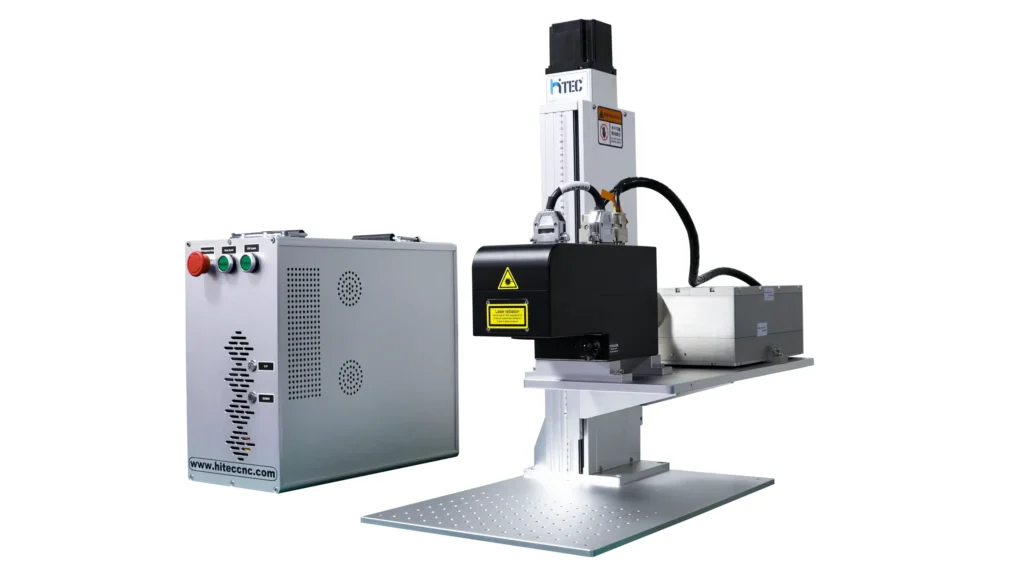
3D fiber laser marking machine for deep engraving, curved-surface marking, and complex industrial applications on metals and other materials.
3D UV laser marking machine for fine, low-heat marking on glass, plastics, electronics, and other sensitive materials.
3D CO2 laser marking machine for high-quality engraving and marking on wood, acrylic, glass, leather, and other non-metal materials.
When 2D Laser Marking Is Not Enough
A conventional 2D laser marker is designed around a fixed focal plane.
That works extremely well for:
- Flat metal plates
- Nameplates
- Logos
- Serial numbers
- QR codes
- Barcodes
- Standard industrial identification
But the processing challenge changes when the workpiece contains significant height variation.
A curved housing, mold cavity, inclined surface or multi-level component may place different areas of the design at different distances from the laser.
The result can be:
- Uneven focus
- Inconsistent spot size
- Reduced detail
- Variable marking quality
- Limited effective processing area
- Additional mechanical repositioning
A 3D dynamic-focus laser system addresses this problem by controlling the focal position during processing.
That is the fundamental reason to choose 3D laser processing:
The laser follows the geometry of the application instead of assuming that every surface is flat.
What Is a 3D Laser Marking Machine?
A 3D Laser Marking Machine is a laser processing system equipped with dynamic focus control for processing surfaces with changing Z height.
Instead of treating the entire design as a single flat plane, the system coordinates laser scanning with focal-position control.
This makes it possible to process:
Flat → Inclined → Stepped → Curved → Irregular → 3D Surfaces
A 3D system can still perform conventional 2D marking. Its value is the additional processing capability when the workpiece geometry or engraving depth makes fixed-focus processing insufficient.
3D Dynamic Focus: The Technology Behind the Process
The key technology is not simply a larger marking field.
It is dynamic control of the laser focus.
During processing, the system coordinates the scanning path and focus position so that the laser can remain within the required focal condition as the surface height changes.
This is particularly important for applications involving:
- Curved surfaces
- Multi-level components
- Inclined surfaces
- Mold cavities
- 3D relief
- Deep engraving
- Complex metal geometries
For deep engraving, dynamic focus can also help maintain processing conditions as material is progressively removed from the surface.
Industrial 3-axis systems use this principle to maintain focus over curved or height-varying features, while advanced 3D marking software can work directly with 3D geometry and surface data.
2D vs. 2.5D vs. 3D Laser Processing
Not every application needs a 3D laser.
The right system depends on what changes during the process.
Processing Type | Typical Capability | Best Suited For |
2D | Fixed focal plane | Flat marking and identification |
2.5D | Variable engraving depth | Relief and multi-pass engraving |
3D | Dynamic Z/focus control | Curved, inclined, stepped and complex surfaces |
2D Laser Marking
Best when the workpiece is essentially flat.
Typical applications include logos, serial numbers, QR codes, barcodes and permanent identification.
2.5D Laser Engraving
Suitable when the design itself contains different engraving depths.
Typical applications include relief effects, logos, lettering and controlled material removal.
3D Laser Processing
Designed for applications where the workpiece surface itself changes in height, or where focus must be controlled as the engraving progresses.
Typical applications include molds, curved components, complex tooling and free-form metal surfaces.
The Important Question
Don’t ask:
“Do I need a 3D laser because it is more advanced?”
Ask:
“Does my application require controlled laser processing across changing surface height or depth?”
If the answer is yes, 3D dynamic focus becomes a functional requirement rather than an optional feature.
What Can You Do With a 3D Laser Marking Machine?
01 — Curved Surface Laser Marking
Process identification, graphics and permanent markings on curved metal components.
Typical parts include:
- Curved housings
- Automotive components
- Cylindrical components
- Formed metal parts
- Mechanical components
- Industrial enclosures
Dynamic focus allows the laser to accommodate changes in surface height rather than relying on a single flat focal plane.
02 — Mold & Tooling Engraving
Molds and tooling are among the most demanding applications for 3D laser engraving.
A mold may contain:
- Cavities
- Ribs
- Steps
- Inclined walls
- Curved surfaces
- Fine details
Different engraving depths
3D laser processing can be used for:
- Mold identification
- Cavity engraving
- Tool numbers
- Logos
- Deep engraving
- Surface texturing
- Relief structures
The machine configuration should be selected according to mold material, hardness, cavity geometry, engraving depth and required production time.
03 — Deep Laser Engraving
Deep engraving is fundamentally different from a simple surface mark.
Material is progressively removed from the workpiece, normally through repeated laser passes.
The result depends on:
- Laser power
- Pulse characteristics
- Scan speed
- Hatch strategy
- Number of passes
- Material
- Required depth
- Thermal control
- Focus position
Deep engraving therefore involves a trade-off between depth, quality and cycle time. Industrial laser manufacturers commonly treat multi-pass strategy and focus control as critical factors in achieving controlled engraving results.
HITEC Laser can evaluate the actual material and required depth through sample testing before final machine configuration.
04 — 3D Relief Engraving
3D relief engraving creates different heights within the same design.
Instead of producing only a surface mark, the laser removes material according to the intended depth profile.
Applications include:
- Logos
- Decorative metal graphics
- Medals
- Industrial patterns
- Tooling details
- Sculpted metal surfaces
Relief engraving can be generated from grayscale or 3D design information, depending on the software workflow and application.
05 — Metal Surface Texturing
3D laser systems can also be configured for controlled surface texturing.
This is particularly relevant to:
- Mold surfaces
- Tooling
- Functional metal surfaces
- Decorative components
- Engineering applications
Texture geometry, depth, material and production requirements determine the appropriate laser source and processing strategy.
3D Laser Marking for Industrial Applications
Mold & Tooling
Deep engraving, cavity identification, tooling numbers, logos and surface texturing.
Automotive
Curved and formed metal components, tooling and permanent identification.
Machinery Manufacturing
Part identification, logos, deep engraving and functional markings.
Metal Fabrication
Permanent component identification and custom industrial marking.
Aerospace & Engineering Components
High-permanence identification and complex metal surface marking.
Jewelry & Decorative Metal
Detailed engraving, relief and complex surface graphics.
3D Laser Engraving for Molds: Where Geometry Matters
For mold manufacturers, the challenge is rarely just “put a logo on metal.”
The real challenge is controlling laser energy while the surface changes.
A mold cavity can contain multiple surface angles and depths. A conventional flat marking system must work within the limitations of a fixed focal plane.
A dynamic-focus system provides another level of control.
Typical Mold Workflow
3D CAD / Design Data
↓
Surface & Processing Strategy
↓
Dynamic Focus Calculation
↓
Galvanometer Scanning + Focus Control
↓
Controlled Material Removal
↓
Final Engraved Surface
This makes 3D laser processing particularly relevant to mold engraving, deep engraving and complex tooling applications.
TRUMPF’s 3D marking software, for example, is designed around 3D CAD-based marking of sloping and curved surfaces, illustrating how industrial 3D laser processing combines optics, motion/control and software rather than treating the dynamic focus head as an isolated component.
Deep Engraving: Power Is Only Part of the Equation
A common mistake when selecting a deep engraving machine is to look only at laser wattage.
Higher power can increase material removal capability, but power alone does not determine engraving quality or productivity.
The process also depends on:
Pulse Characteristics
Pulse duration, frequency and pulse energy affect material interaction and heat input.
Scan Strategy
Hatch spacing, scan direction and overlap influence removal efficiency and surface quality.
Number of Passes
Deep engraving is generally a multi-pass process. The required number of passes increases with engraving depth and depends strongly on the selected parameters.
Focus Control
As material is removed, the actual processing surface moves downward.
Maintaining appropriate focus becomes increasingly important for deeper structures.
Thermal Management
Excessive heat can affect dimensional stability, edge definition and surface finish.
Therefore, the correct question is not:
“How many watts do I need?”
It is:
“What material, depth, feature size and cycle time do I need to achieve?”
That is how the machine should be specified.
Designed for Metal Processing
HITEC Laser 3D fiber laser systems can be configured for a wide range of industrial metals, including:
- Stainless steel
- Carbon steel
- Tool steel
- Hardened steel
- Aluminum
- Brass
- Copper
- Titanium
- Other metal alloys
The optimal laser configuration depends on the material composition, surface condition, required mark or engraving type and production target.
For difficult or high-value applications, sample testing is strongly recommended before machine selection.
Designed for Metal Processing
HITEC Laser 3D fiber laser systems can be configured for a wide range of industrial metals, including:
- Stainless steel
- Carbon steel
- Tool steel
- Hardened steel
- Aluminum
- Brass
- Copper
- Titanium
- Other metal alloys
The optimal laser configuration depends on the material composition, surface condition, required mark or engraving type and production target.
For difficult or high-value applications, sample testing is strongly recommended before machine selection.
How to Choose the Right 3D Laser Marking Machine
- Material
What metal are you processing?
- Geometry
Is the surface flat, curved, stepped, inclined or free-form?
- Processing Type
Do you need:
Marking
Engraving
Deep engraving
Relief
Texturing
- Required Depth
A 50 μm surface effect and a 1 mm deep engraving are completely different applications.
- Feature Size
Fine graphics and deep material removal can require very different processing strategies.
- Working Area
The required field determines the optical configuration and affects achievable spot size and processing performance.
- Production Target
A prototype application and a high-volume production line should not necessarily use the same configuration.
The best 3D laser marking machine is the one configured around your process — not the machine with the largest wattage specification.
Why HITEC Laser?
Application-First Engineering
We start with the material, geometry and required result — not with a predetermined machine configuration.
Industrial Laser Expertise
HITEC Laser focuses on industrial laser marking, engraving and specialized laser processing applications.
Configurable Laser Power
Different laser power levels and source configurations are available according to the actual process requirement.
3D Dynamic Focus
Designed for applications where surface height and engraving depth change during processing.
Sample-Based Validation
For critical applications, the actual workpiece and required result should be validated before final machine selection.
Global B2B Support
HITEC Laser works with international customers requiring application-specific machine configuration, technical documentation and production-oriented solutions.
From Sample to Production
A professional 3D laser solution should be validated before purchase.
Send HITEC Laser:
- Material
Stainless steel, tool steel, aluminum, brass, titanium, etc.
- Workpiece
Dimensions, photos and surface geometry.
- Design
2D graphic, 3D model, STL or other available design data.
- Required Result
Marking, engraving, depth, relief or texture.
- Production Target
Quantity per day, cycle-time requirement or expected production volume.
We can then evaluate:
- Laser source
- Laser power
- Dynamic focus configuration
- Optical field
- Rotary requirements
- Processing strategy
- Expected result
3D Laser Marking Machine Specifications
Specification | HITEC Laser Configuration |
Laser Type | Fiber Laser |
Wavelength | 1064 nm |
Laser Power | 50W–500W, application-dependent |
Focus System | 3D Dynamic Focus |
Processing | 2D / 2.5D / 3D |
Laser Processing | Marking / Engraving / Deep Engraving / Relief / Texturing |
Rotary Axis | Optional |
Laser Source | JPT / IPG and other application-dependent configurations |
Software | 3D-compatible laser marking software |
Materials | Industrial metals |
Configuration | Application-specific |
Frequently Asked Questions
What is a 3D laser marking machine?
A 3D laser marking machine uses dynamic focus control to process surfaces with changing height, including curved, inclined, stepped and irregular surfaces.
What is the difference between 2D and 3D laser marking?
2D laser marking is primarily designed around a fixed focal plane. 3D laser marking adds dynamic focus control for processing surfaces with significant height variation.
Can a 3D laser also mark flat metal?
Yes. A 3D laser system can perform conventional 2D marking as well as more advanced 3D processing.
Can a 3D laser engrave molds?
Yes. 3D laser systems are particularly suitable for mold and tooling applications involving cavities, varying surface heights, deep engraving and complex geometries.
Can it perform deep engraving?
Yes. With an appropriate laser source and processing strategy, a 3D laser can be configured for deep metal engraving. Depth, material and required cycle time determine the appropriate configuration.
Does 3D mean the laser can engrave any 3D shape?
No. The achievable geometry depends on the dynamic focus range, optical configuration, software, workpiece geometry and application requirements.
Does 3D laser marking require a 3D file?
Not necessarily. The required data depends on the application and software workflow. Conventional 2D graphics can still be processed, while complex 3D surface applications may benefit from 3D CAD or surface data.
Can I use a rotary axis with a 3D laser?
Yes. A rotary axis can be configured for cylindrical and rotational workpieces when the application requires it.
Can HITEC Laser test my workpiece?
Yes. For complex 3D applications, sample testing is recommended before final machine configuration.
Frequently Searched 3D Laser Applications
3D Laser Marking Machine
For industrial marking on complex metal surfaces.
3D Laser Engraving Machine
For variable-depth engraving and 3D metal graphics.
3D Mold Engraving Machine
For mold cavities, tooling, deep engraving and surface details.
Deep Laser Engraving Machine
For controlled material removal on metal components.
Curved Surface Laser Marking
For curved, inclined and height-varying workpieces.
3D Metal Engraving Machine
For industrial metal engraving, relief and complex surface processing.