Laser Cutting Machine
Fiber Laser Cutting Systems for Metal, Tube & Precision Applications
HITEC Laser provides fiber laser cutting machines engineered for precision metal cutting, flexible production and application-specific manufacturing.
From sheet metal and plate cutting to tube, profile and jewelry cutting, our laser cutting systems are configured around the material, thickness, part geometry, production volume and required cutting performance.
Whether you need a flexible machine for general metal fabrication, a dedicated tube laser cutter for complex profiles, or a precision system for jewelry production, HITEC Laser can provide a configuration matched to the process.
Laser Cutting Machines for Different Production Requirements
The right system depends on what you cut, how thick it is, how large the workpiece is, how complex the geometry is, and how many parts you need to produce.
HITEC Laser organizes its laser cutting solutions around three primary applications:
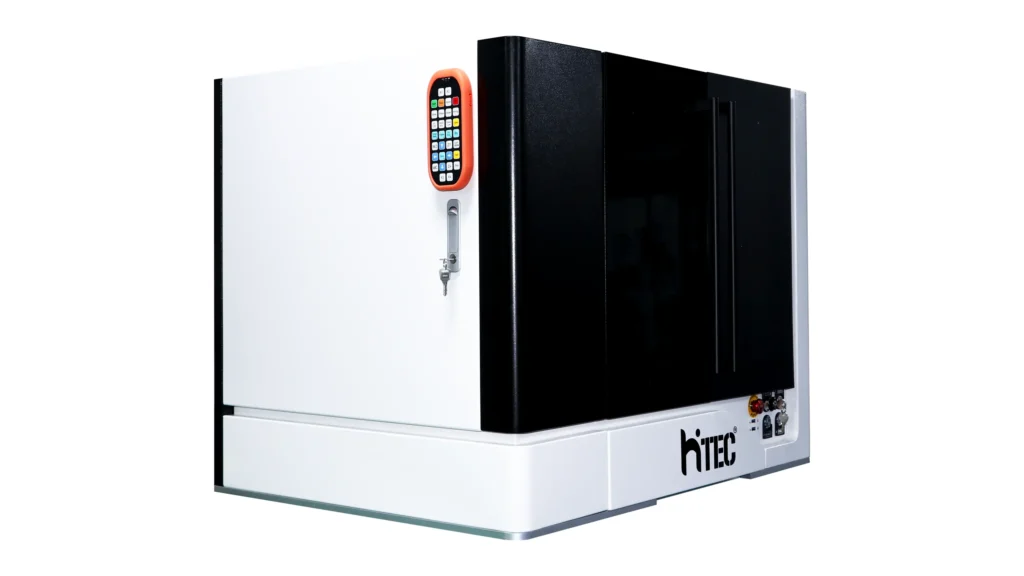
Compact laser cutting machine for jewelry, providing high-precision cutting of gold, silver, and other precious metals. Ideal for intricate designs, detailed engraving, and low-volume production with minimal material waste.
Laser Cutting Machine Portfolio
Choose the System Around Your Process
Different production environments require different laser cutting architectures.
Rather than selecting a machine based only on laser power, HITEC Laser considers the complete process:
Material → Thickness → Geometry → Cutting Area → Accuracy → Throughput → Automation
Metal Plate Laser Cutting Machine
Typical applications:
- Sheet metal fabrication
- Industrial parts
- Machinery components
- Metal panels
- Enclosures
- Structural components
- Custom fabrication
View Plate Metal Laser Cutters →
Tube Laser Cutting Machine
Designed for precision processing of metal tubes and profiles.
Tube laser cutting can combine multiple cutting operations into a single process, including holes, slots, contours and end features. This can reduce downstream machining, drilling and manual fabrication steps. Leading tube-laser manufacturers position this reduction in secondary operations as a major production advantage.
Typical applications:
- Round tubes
- Square tubes
- Rectangular tubes
- Structural profiles
- Furniture components
- Automotive components
- Machinery frames
- Agricultural equipment
View Tube Laser Cutters →
Jewelry Laser Cutting Machine
Designed for precision cutting of precious metals and small components where fine features, edge quality and controlled thermal input are important.
Typical applications:
- Gold
- Silver
- Platinum
- Jewelry components
- Rings
- Pendants
- Decorative parts
- Fine metal components
View Jewelry Laser Cutters →
Why Fiber Laser Cutting?
For modern metal fabrication, fiber laser technology offers a combination of high cutting speed, precision, flexibility and process efficiency.
The value of a fiber laser cutting machine is not simply the laser source itself. Cutting performance depends on how the laser source, cutting head, motion system, machine structure, software and process parameters work together.
A well-configured system can provide:
High Cutting Productivity
Efficient laser-material interaction allows high-speed cutting across many common metal applications.
Precise Part Geometry
Computer-controlled motion and laser processing enable repeatable contours and detailed features.
Flexible Material Processing
Fiber laser systems can be configured for materials such as:
- Carbon steel
- Stainless steel
- Aluminum
- Brass
- Copper
- Titanium
- Other metal alloys
Reduced Secondary Processing
Laser cutting can produce finished contours, holes and features directly from digital designs, reducing the need for conventional drilling, punching and machining in many applications.
Digital Production
CAD/CAM workflows allow designs to move from digital files to production with minimal manual intervention.
What Can a Laser Cutting Machine Cut?
The exact capability depends on laser power, material, thickness, cutting head, assist gas, optical configuration and process parameters.
Carbon Steel
Commonly processed for:
- Structural components
- Machinery parts
- Frames
- Brackets
- Fabricated assemblies
Stainless Steel
Suitable for:
- Enclosures
- Decorative components
- Food-processing equipment
- Industrial equipment
- Precision fabricated parts
Aluminum
Widely used for:
- Lightweight structures
- Automotive components
- Electrical enclosures
- Industrial parts
Brass & Copper
Require appropriate laser and process configurations because of their optical and thermal properties.
Applications include:
- Electrical components
- Decorative parts
- Industrial fittings
- Precision components
Titanium
Used in demanding engineering applications where controlled cutting and material-specific parameters are required.
From Digital Design to Finished Part
Modern laser cutting is more than moving a laser over a sheet.
The complete production workflow can be organized as:
CAD Design
↓
Nesting
↓
Process Planning
↓
Laser Cutting
↓
Part Unloading
↓
Sorting / Downstream Processing
The machine is only one part of the production system.
International manufacturers increasingly emphasize the entire production flow — including software, automation, loading, unloading, sorting and process monitoring — because machine cutting time is only one part of total manufacturing productivity. TRUMPF explicitly highlights upstream and downstream processes as important optimization opportunities, while Bystronic integrates laser cutting with automation and software as part of its broader sheet-metal processing approach.
Cutting Performance Is More Than Laser Power
A common mistake when comparing laser cutting machines is to compare only:
3 kW vs. 6 kW vs. 12 kW vs.20kW vs. 30kW
Laser power matters, but it is only one part of the system.
Actual production performance depends on:
Laser Source
Determines available optical power and influences cutting capability.
Cutting Head
Controls beam delivery, focus position and interaction with the material.
Motion System
Determines acceleration, positioning accuracy and dynamic cutting performance.
Machine Structure
Mechanical stability affects accuracy and repeatability.
Assist Gas System
Oxygen, nitrogen or other process gases influence cutting speed, edge quality and operating cost.
Cutting Parameters
Speed, focus position, gas pressure, nozzle selection and material-specific parameters all affect the final result.
Software
Programming, nesting and process optimization directly affect material utilization and production efficiency.
Automation
Loading, unloading and sorting can become increasingly important as production volume increases.
This is why an industrial laser cutter should be evaluated as a complete manufacturing system, not simply by its nominal wattage.
Laser Cutting Applications
Metal Fabrication
Cut brackets, panels, frames, covers and custom components directly from digital designs.
Machinery Manufacturing
Produce precision components, structural parts and machine enclosures.
Automotive
Process sheet metal, tubes and profiles for components and fixtures.
Furniture
Tube and sheet laser cutting enables complex designs with fewer secondary fabrication steps.
Electrical & Electronics
Cut enclosures, panels and precision metal components.
Construction
Process structural components, brackets and architectural metal parts.
Agriculture
Cut structural profiles, machine components and agricultural equipment parts.
Jewelry
Precision cutting of precious metals and intricate components.
How to Choose a Laser Cutting Machine
- Define Your Material
Start with the materials you actually process.
Carbon steel, stainless steel, aluminum, copper and brass behave differently during laser cutting.
- Define Your Thickness Range
Do not select the machine based only on your maximum thickness.
Look at your typical production mix.
A machine optimized for occasional thick-plate work may not necessarily be the most productive choice for a business cutting thin and medium-gauge sheet every day.
- Define Your Workpiece Geometry
Are you cutting:
Flat Sheet?
Choose a plate/sheet laser cutting system.
Tube & Profiles?
Choose a tube laser cutter.
Small Precision Components?
Consider a precision-oriented system such as a jewelry laser cutter.
- Define Your Production Volume
Ask:
How many parts per day?
How many hours per shift?
How often do materials change?
How much operator intervention is acceptable?
Do you need automatic loading and unloading?
5. Calculate Cost Per Part
Purchase price alone does not determine the economics of a laser cutter.
Consider:
Machine Cost
Laser Power Consumption
Assist Gas
Consumables
Labor
Maintenance
Material Utilization
Production Throughput
=
Total Cost of Production
A faster machine may justify a higher initial investment if it produces more usable parts per hour or reduces labor and secondary operations.
Automation: From Machine to Production System
As production volume increases, automation becomes increasingly important.
Possible automation levels include:
Manual Loading
Suitable for lower production volumes and high product variety.
Semi-Automatic Loading
Reduces repetitive operator handling.
Automatic Loading & Unloading
Improves machine utilization and reduces manual intervention.
Automated Sorting
Useful when multiple part types are produced from the same sheet.
Material Storage Integration
Allows raw materials to be managed as part of a connected production system.
International manufacturers increasingly treat automation, software and machine tools as a unified production environment rather than independent products.
Why Choose HITEC Laser?
Application-Driven Configuration
We select the laser cutting system according to your material, thickness, geometry and production requirements.
Fiber Laser Technology
Designed for efficient metal cutting across a broad range of industrial applications.
Multiple Cutting Solutions
From flat sheet and plate processing to tube and precision jewelry cutting.
Production-Oriented Engineering
Machine configuration considers not only cutting speed but also material utilization, operator workflow and production requirements.
Sample Testing
For applications with demanding material, thickness or edge-quality requirements, sample testing provides a practical basis for machine selection.
International B2B Support
HITEC Laser provides machine configuration and application support for international customers looking for production-ready laser cutting solutions.
Laser Cutting Machine Specifications
Because laser cutting systems are application-dependent, HITEC Laser does not treat one configuration as suitable for every customer.
The final machine specification can include:
Configuration | Selection Basis |
Laser Type | Fiber laser |
Laser Power | Material + thickness + production target |
Working Area | Raw material + part dimensions |
Cutting Head | Material + thickness + process requirements |
Machine Structure | Required accuracy + dynamic performance |
Drive System | Positioning + acceleration requirements |
Assist Gas | Material + thickness + edge quality |
CNC / Control | Machine architecture + production workflow |
Nesting Software | Material utilization + production planning |
Automation | Production volume + labor requirements |
Rotary / Tube System | Tube and profile applications |
Cooling | Laser power + operating environment |
The correct specification is determined by the application, not by maximum machine capacity alone.
Frequently Asked Questions
What is a laser cutting machine?
A laser cutting machine uses a focused laser beam to melt, burn, vaporize or otherwise remove material along a programmed cutting path. Industrial fiber laser systems are widely used for precision cutting of metals.
What is a fiber laser cutting machine?
A fiber laser cutting machine uses a fiber-delivered solid-state laser source to process materials. Fiber lasers are widely used for industrial metal cutting because of their efficiency, beam quality and suitability for a broad range of metal applications.
What metals can a fiber laser cutter cut?
Depending on configuration, fiber laser systems can process carbon steel, stainless steel, aluminum, brass, copper, titanium and other metals.
How do I choose laser power?
Choose power according to your actual material and thickness range, required cutting speed, edge quality and production volume. Maximum thickness alone should not determine the laser power.
Is a higher-power laser always better?
No. Higher power can increase cutting capability and productivity in appropriate applications, but the economic benefit depends on your material mix, thickness, production volume and utilization.
What is the difference between a plate laser cutter and a tube laser cutter?
A plate laser cutter is designed primarily for flat sheet and plate material. A tube laser cutter uses dedicated clamping, rotation and motion systems to process tubes and profiles around their geometry.
Can a tube laser replace drilling and machining?
In many applications, yes. Tube laser systems can cut holes, slots, notches and other features directly into profiles, potentially reducing secondary drilling, milling and fabrication operations. The actual reduction depends on the part design and process requirements.
Can a laser cutting machine cut copper and brass?
Yes, with an appropriate fiber laser configuration and process parameters. Copper and brass require particular consideration because of their optical and thermal properties.
Does laser cutting require nitrogen?
Not always. Assist-gas selection depends on material, thickness, desired edge condition and application. Oxygen and nitrogen are commonly used for different cutting requirements.
What affects laser cutting quality?
Major factors include laser power, beam quality, focus position, nozzle condition, assist gas, cutting speed, material characteristics and machine dynamics.